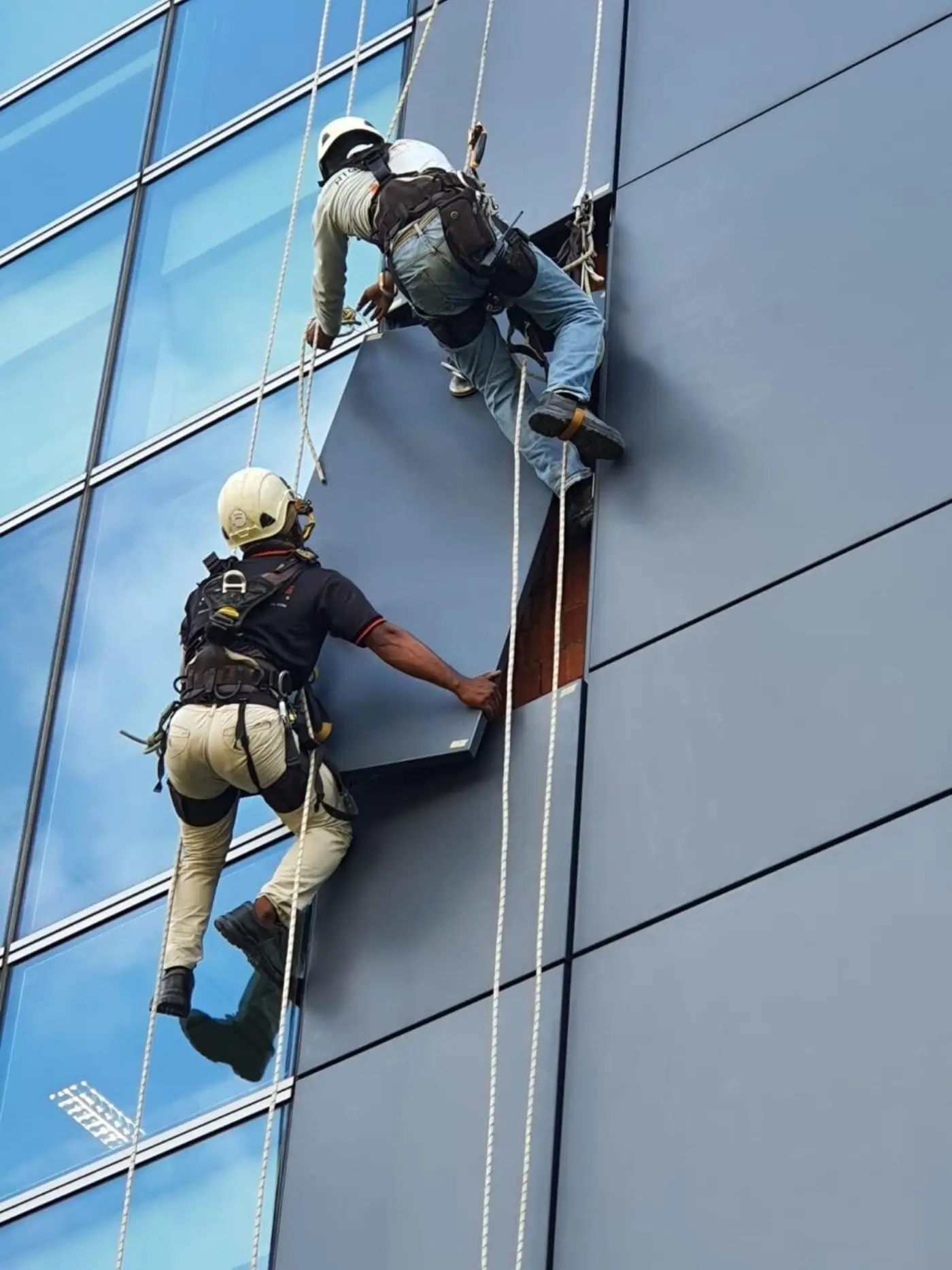
Safety planning
Method statements, exclusion zones and rescue plans.
Most work-at-height incidents trace back to planning, not equipment. A clear method, a written risk assessment, a sensible exclusion zone and a rehearsed rescue plan reduce the most common failure modes.
What sits in a height-work plan
A height-work plan is a short, working document — not a generic policy. It is written for the actual building, the actual scope, and the actual surrounding activity.
Core elements
- Scope & sequence: what is being done, in what order, over what duration.
- Access method: rope access, boomlift, scissor lift, scaffold, or a combination.
- Anchorage & PPE: anchor points, twin-rope set-up, harness model, energy absorbers.
- Exclusion zone: ground footprint, cones, barricades, public diversion path.
- Stop-work thresholds: wind speed, rain, lightning, surrounding works.
- Rescue plan: primary method, secondary fall-back, who is responsible, equipment location.
- Permits & toolbox: permit-to-work coordination, daily briefing attendance.
Common failure modes we plan against
- Anchor doubt — using an unverified bolt or eye on a roof.
- Falling object — untethered tools or material near a public path.
- Suspension trauma — long hang time without a rescue plan.
- Wind shift — boomlift platform exceeding rated wind limits.
- Rescue confusion — no named rescue lead on site.
- Permit gap — work starts before the building issues the permit.
Working in Singapore
MOM-aligned, building-permit aware.
Work at height in Singapore is governed by the Workplace Safety and Health (Work at Heights) Regulations and venue-specific permit systems. Our plans are written to be readable by both the building and the regulator, not just our own team.