Start with delivery and the narrowest constraint
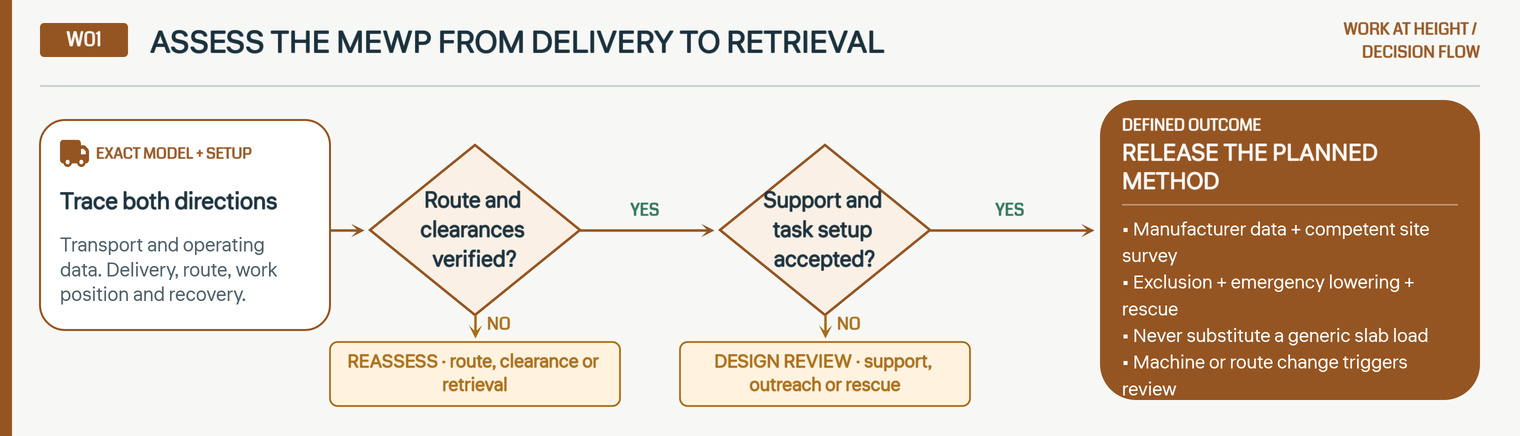
Mark where the delivery vehicle can stop, unload and recover the machine. Trace both inbound and outbound travel. Record clear widths, heights, turning space, gradients, kerbs, drains, grilles, covers and changes in surface. A machine that fits the work face may still fail at a gate, ramp, overhead service or reversing point.
Use the exact proposed model and configuration. Transport dimensions can differ from operating dimensions, and attachments or options may change the assessment. Keep a route sketch with photographs, measured clearances and unresolved confirmations so the delivered machine can be checked against the assessed machine.
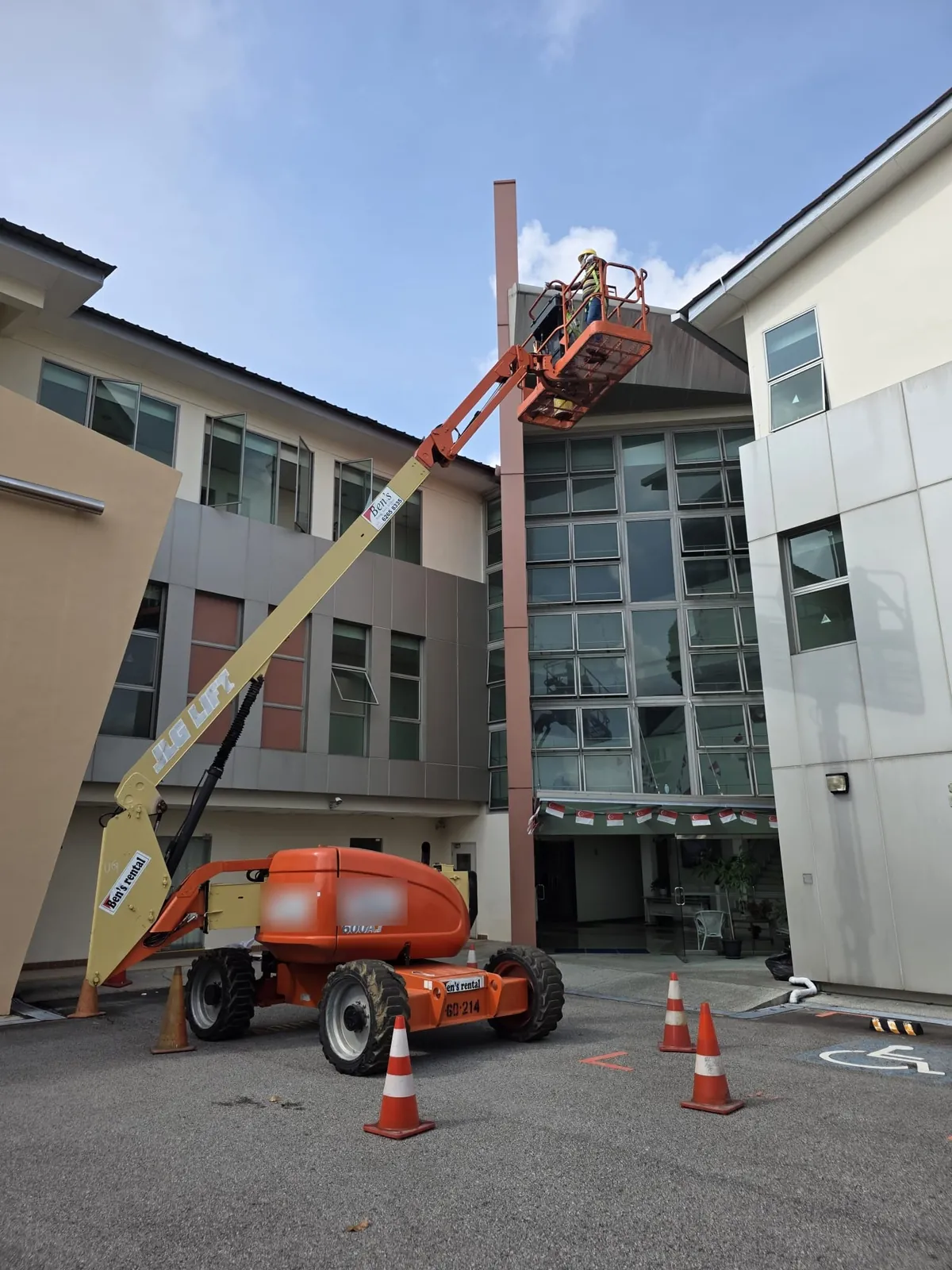
Before booking, ask the hire company for the exact model’s stowed width, length and height, its turning radius and its weight. Compare each figure with the narrowest door, gate, ramp and turn on the route, in both directions. If a figure is missing or the margin is tight, settle it before the machine is booked, not on delivery day; WSH Council guidance calls for a clear path of travel for the MEWP. [1]
Confirm support along the whole route
Obtain the model’s operating weight and the relevant wheel, track or outrigger loading information. Include unloading, travelling, setup and work positions. Where the route crosses a suspended slab, basement, buried service, cover or uncertain ground, give that data to the building team or relevant design professional for review. A smooth finish does not establish adequate support.
Do not use a generic allowable suspended-slab load. WSH Council MEWP guidance calls for a competent site survey and selection of a suitable machine for the task and ground conditions, together with manufacturer’s instructions and pre-use checks. [1]
Check the task, exclusion and fallback
At the final position, confirm outreach, rated load, overhead obstructions, entrapment and collision exposure, nearby traffic and people, setup space, emergency lowering and rescue arrangements. Review the work under the site risk assessment and the hierarchy of controls; significant changes in machine, route or procedure should trigger review of the assessment and controls. [2] [3]
Check the ground slope at every setup and work position, not only along the route, against the manufacturer’s maximum allowable slope for the selected model. WSH Council guidance says not to operate MEWPs on slopes beyond the manufacturer’s specifications. [1] On a machine fitted with a tilt alarm, going past the limit sounds the alarm and locks out some or all platform functions (the model’s manual says which), so the work cannot go ahead from that position. Plan level setup points, or another access method, before the machine arrives.
If one constraint fails, reassess the exact location before choosing another machine, setup point or access method. Record whether the fallback introduces a new delivery route, ground condition or public interface. Avoiding work at height where the task can safely be performed otherwise remains the starting duty so far as reasonably practicable.
Related: see our boomlift and scissor lift access.
Read next: MEWP and Boom Lift Safety Singapore.
Read next: How to Sequence Ceiling Works When Several Contractors Share One Lift.
Practical checklist
- Match the delivered model and configuration to the assessed data sheet.
- Get the exact model’s stowed width, length, height, turning radius and weight from the hire company and check them against the narrowest door, gate, ramp and turn.
- Include unloading and retrieval in the route and support review.
- Check the ground slope at each setup and work position against the model’s maximum allowable slope; plan level setup points or another method where it is exceeded.
- Resolve slab, cover and buried-service questions with the relevant professional.
- Confirm entrapment, rescue and public-exclusion arrangements before mobilisation.
References
- Workplace Safety and Health Council. (2022). Guide for safe use of mobile elevating work platforms.
- Workplace Safety and Health (Risk Management) Regulations (Singapore), regs. 3–5 and 7. Singapore Statutes Online.
- Workplace Safety and Health (Work at Heights) Regulations 2013 (Singapore), regs. 4–7. Singapore Statutes Online.