Map dependencies before choosing the machine
List the bays, every task above and below them, the required access openings, inspections, tests and reinstatement steps. A sequence might be ceiling access → services work → inspection or testing → release → reinstatement. Ask each trade what must be complete before it starts and what evidence it will leave.
Confirm that the proposed platform suits each task’s reach, rated load, occupants, tools and materials. Identify any fire-rated assembly so that deviations, openings and reinstatement are reviewed with the relevant project professional. Do not let a shared-lift efficiency target determine a technical acceptance decision.
Control the lift and the area below between trades
WSH Council MEWP guidance supports trained and authorised operators, manufacturer’s instructions, pre-use checks, rated-load compliance and planning for overhead obstacles, entrapment, collision, overturning and rescue. Record who operates the lift, who supervises each move and who controls exclusion below. A new trade does not inherit a verbal assumption that the previous setup remains suitable. [1]
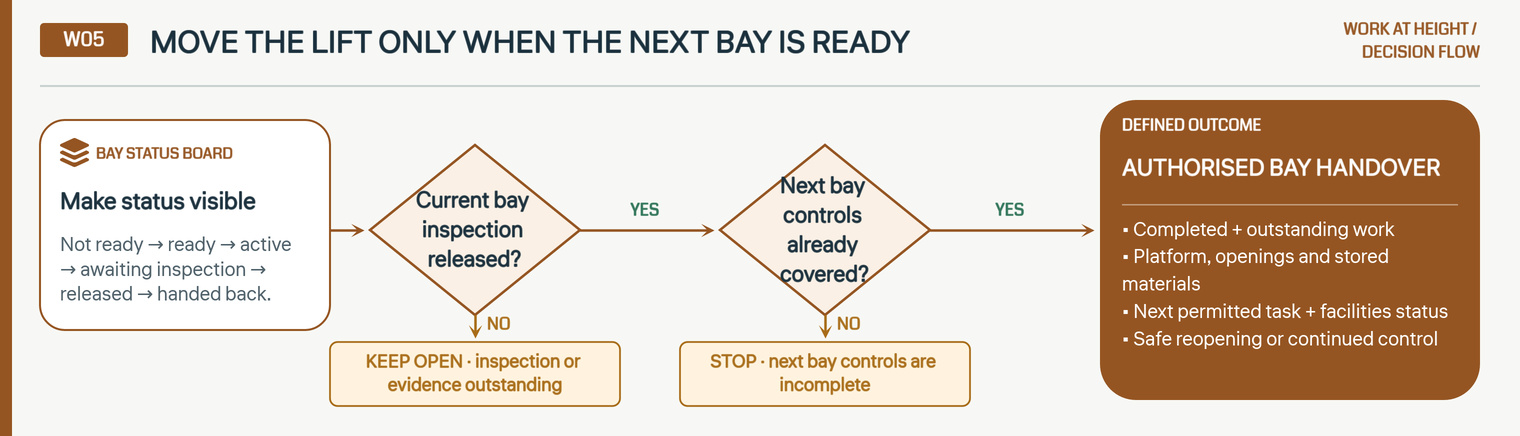
Use a short bay handover covering completed work, outstanding inspection, stored materials, platform condition, temporary supports, ceiling openings and the next permitted task. Keep time for inspections and relocation; otherwise the programme will pressure teams to close a bay before it is released.
Pre-assess what happens when a dependency slips
If Bay A awaits electrical inspection, keep it open and marked ‘awaiting inspection’. Move to Bay B only if its area release, operator arrangements, machine suitability, exclusion and rescue controls are already covered. Otherwise stop and resequence. Use simple statuses: not ready, ready, work active, awaiting inspection, released for reinstatement and handed back.
Review the risk assessment when work practices or procedures change significantly. By shift end, facilities should know which zones are safe to reopen, which remain controlled and what evidence or return visit is outstanding. [2]
Related: see our boomlift and scissor lift access.
Read next: Fire-Rated Ceiling Handover in Singapore.
Read next: MEWP and Boom Lift Safety Singapore.
Practical checklist
- Give every bay one visible status and one named clearance authority.
- Confirm lift load, reach and operator authorisation for each task.
- Do not close fire-rated or inspected work before the required release.
- Pre-assess fallback bays rather than improvising around a delay.