Plan around the shift that must continue
Bring the warehouse supervisor, traffic lead and access contractor together before fixing dates. Identify dock cut-offs, fast-moving stock, replenishment peaks and lanes that must remain available. Put pedestrian routes, forklift routes, crossings, loading positions and affected storage lanes on one current plan.
WSH Council forklift guidance supports a workplace traffic-management plan that separates pedestrians, forklifts and other vehicles and communicates routes and controls. A barrier around the lift is only one part of that system; diversion decisions must be made before the contractor arrives. [1]
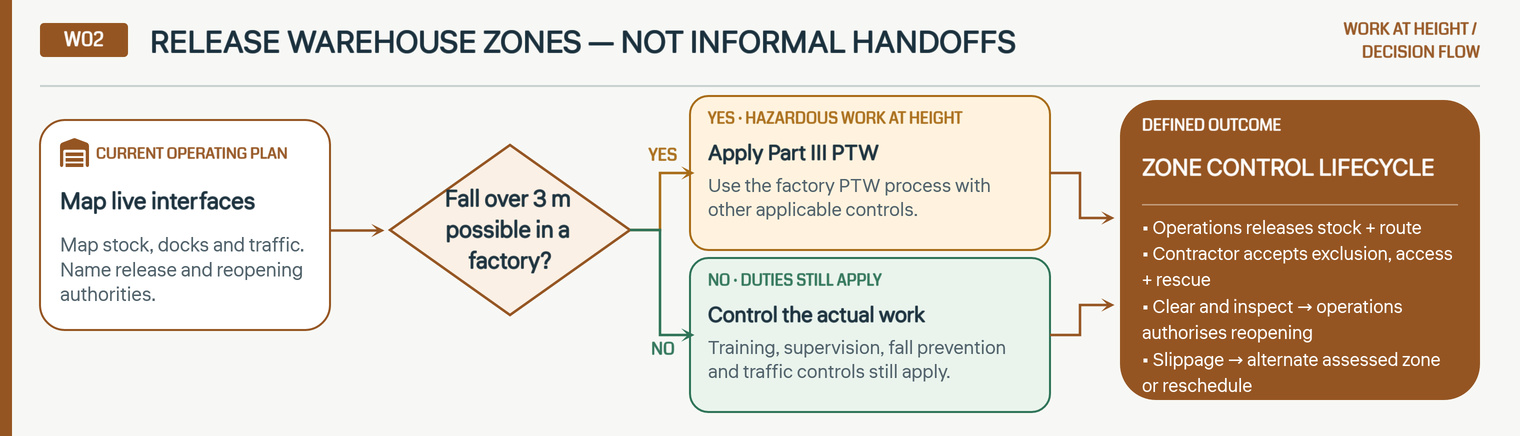
Give every work zone a release and handback
For example, operations releases aisle C after the morning pick, removes the required stock and redirects vehicles. The contractor accepts the zone only after exclusion, access and rescue controls are in place. At handback, the team removes tools and materials, accounts for ceiling or overhead condition, and tells the warehouse lead that the agreed checks are complete. Operations then authorises and communicates reopening.
Record the people who can release, suspend and reopen the area. If dispatch runs late, use a pre-assessed alternate zone or reschedule. Do not improvise around live traffic because the original programme has slipped.
Apply the permit-to-work condition precisely
Hazardous work at height under the Work at Heights Regulations involves a potential fall of more than 3 metres. Part III permit-to-work duties apply to hazardous work at height carried out at a factory. Check factory status carefully: the WSH Act definition includes premises where mechanical power such as forklifts is used to handle or store goods, and premises where building operations, including repair or maintenance, are carried out. Permit-to-work is not a universal requirement for every task in every building. [5] Training, supervision, fall prevention and other applicable duties still need to be addressed according to the workplace and work. [2] [3]
A different machine, temporary stockpile or changed forklift route can alter the risk picture. Suspend the affected work while the assessment, safe work procedure and communications are reviewed. Risk assessments must also be reviewed at the statutory intervals and after relevant injury or significant changes in work practices or procedures. [4]
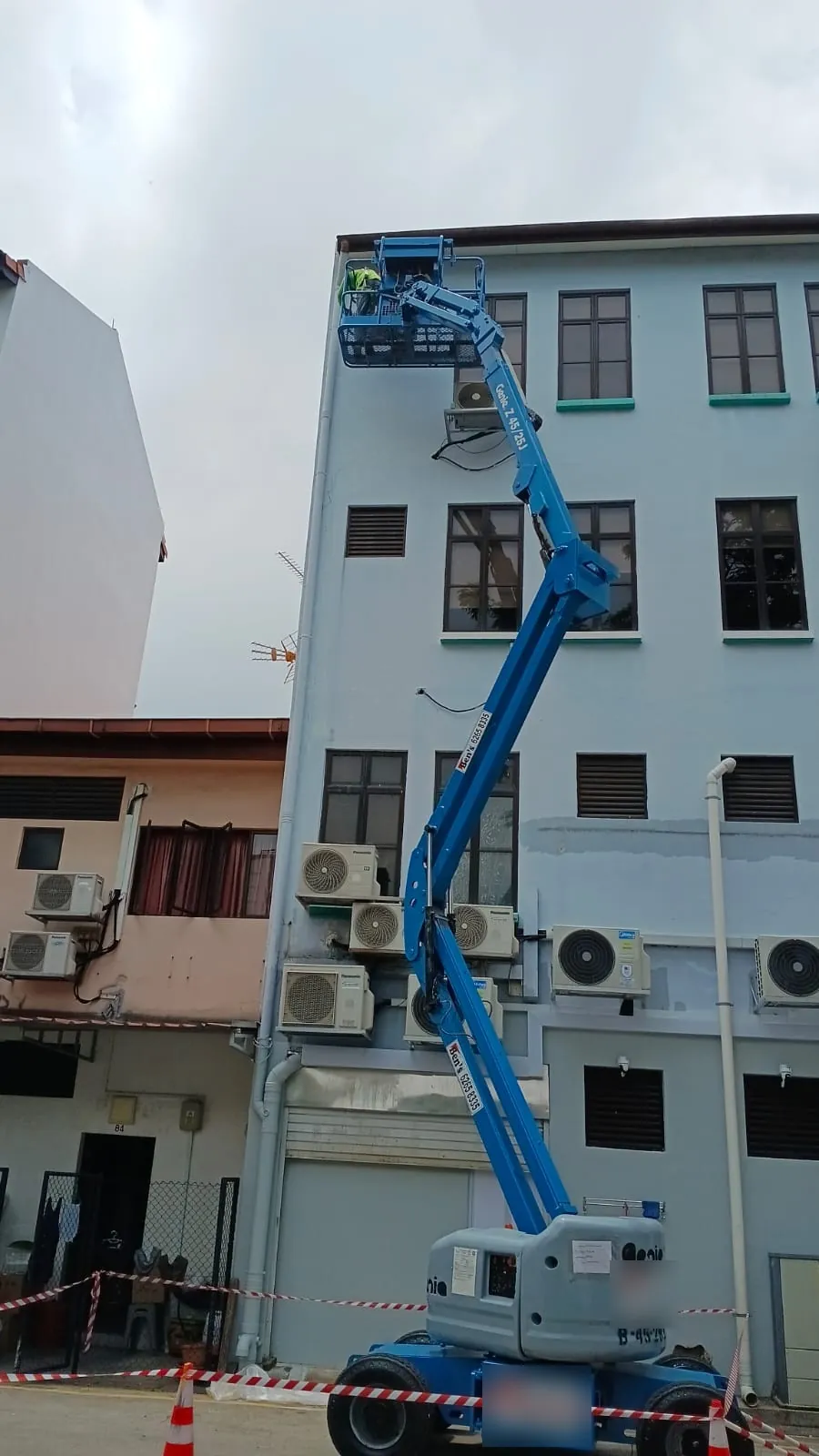
Related: see our boomlift and scissor lift access.
Read next: Permit-to-Work System for Hazardous Work at Height.
Read next: Daytime or Overnight? How to Schedule High-Level Maintenance.
Practical checklist
- Use one current plan for pedestrians, forklifts, work zones and diversions.
- Name who releases, suspends and reopens each area.
- Pre-assess any alternate zone before switching the programme.
- Confirm factory status with the occupier: forklift warehouses and premises with building works can be factories.
References
- Workplace Safety and Health Council. (2012). Workplace safety and health guidelines: Safe operation of forklift trucks.
- Workplace Safety and Health (Work at Heights) Regulations 2013 (Singapore), regs. 2–3 and 20–28. Singapore Statutes Online.
- Workplace Safety and Health Council. (n.d.). Preventing falls from heights.
- Workplace Safety and Health (Risk Management) Regulations (Singapore), regs. 3–5 and 7. Singapore Statutes Online.
- Workplace Safety and Health Act 2006 (Singapore), s. 5 and Fourth Schedule. Singapore Statutes Online.