This article sets out the practical trade-offs between the four methods most commonly used for facade works, maintenance and inspection in Singapore — rope access, boom lifts (MEWPs), scaffolding and gondolas (suspended working platforms). None is universally superior. Each suits a defined range of site conditions and work scopes.
Understanding the selection framework
The Workplace Safety and Health (Work at Heights) Regulations and the associated MOM-approved Code of Practice for Working Safely at Heights require that access methods be selected based on a site-specific risk assessment. The hierarchy of controls applies: where collective protection (such as scaffolding or a barricaded platform) is practicable, it should generally be preferred over reliance on personal fall protection equipment alone.
In practice, collective protection is not always structurally or logistically achievable on completed buildings. All four methods below are legitimate means of access for specific applications.
Scaffolding
A temporary structure of tubes, couplers or system components erected to provide a working platform at the required level.
Best suited for
Projects requiring sustained access to large facade areas, external painting programmes, window or cladding replacement, and any scope requiring workers to spend extended time at height across multiple trades.
Advantages
- Provides a stable, enclosed working platform.
- Supports heavier materials and multiple workers simultaneously.
- Collective fall protection — guardrails, toe boards and a working deck reduce reliance on personal fall arrest.
- Accessible to workers without specialist rope skills.
Limitations
- Erection and dismantling time is significant — typically days to weeks for a full-facade scaffold.
- Requires a Professional Engineer (PE) design above the threshold prescribed in the WSH (Scaffolds) Regulations.
- Ground footprint can be substantial; not suitable in narrow pedestrian corridors without coordination.
- Not practical for single-visit close-range inspection of a limited facade area.
Gondola (suspended working platform)
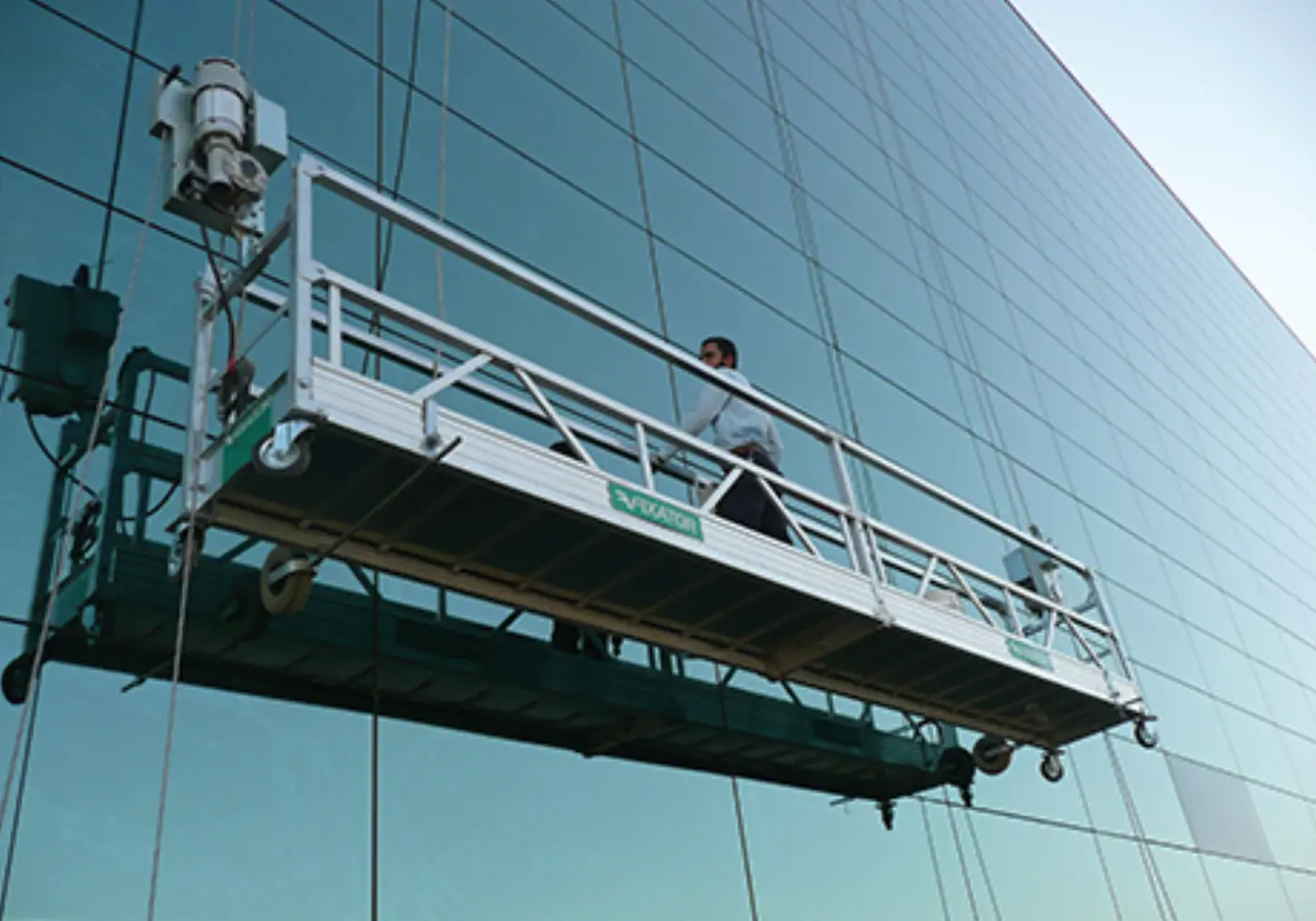
A powered or manually operated suspended platform hung from davit arms, monorails or parapet-mounted outriggers, capable of being raised and lowered along the building facade.
Best suited for
High-rise buildings with existing or purpose-installed suspension anchorage systems — facade cleaning, repainting, sealant and joint repair, and facade inspection requiring repeated access across multiple visits.
Advantages
- Efficient vertical and horizontal travel once rigged.
- Can access full building height without ground equipment.
- Established method for Singapore high-rise maintenance — many buildings are designed with gondola tracks.
Limitations
- Outriggers and overhead supports must be designed by a Professional Engineer for the specific building.
- The gondola system (platform, winches, hoist ropes and anchorage) should be examined by an Authorised Examiner before use and at the intervals prescribed by regulation.
- Safe working load must be clearly marked; overloading is a primary risk factor.
- Not suitable for facades with significant horizontal offsets, fins or projections.
Boom lift / MEWP (Mobile Elevating Work Platform)
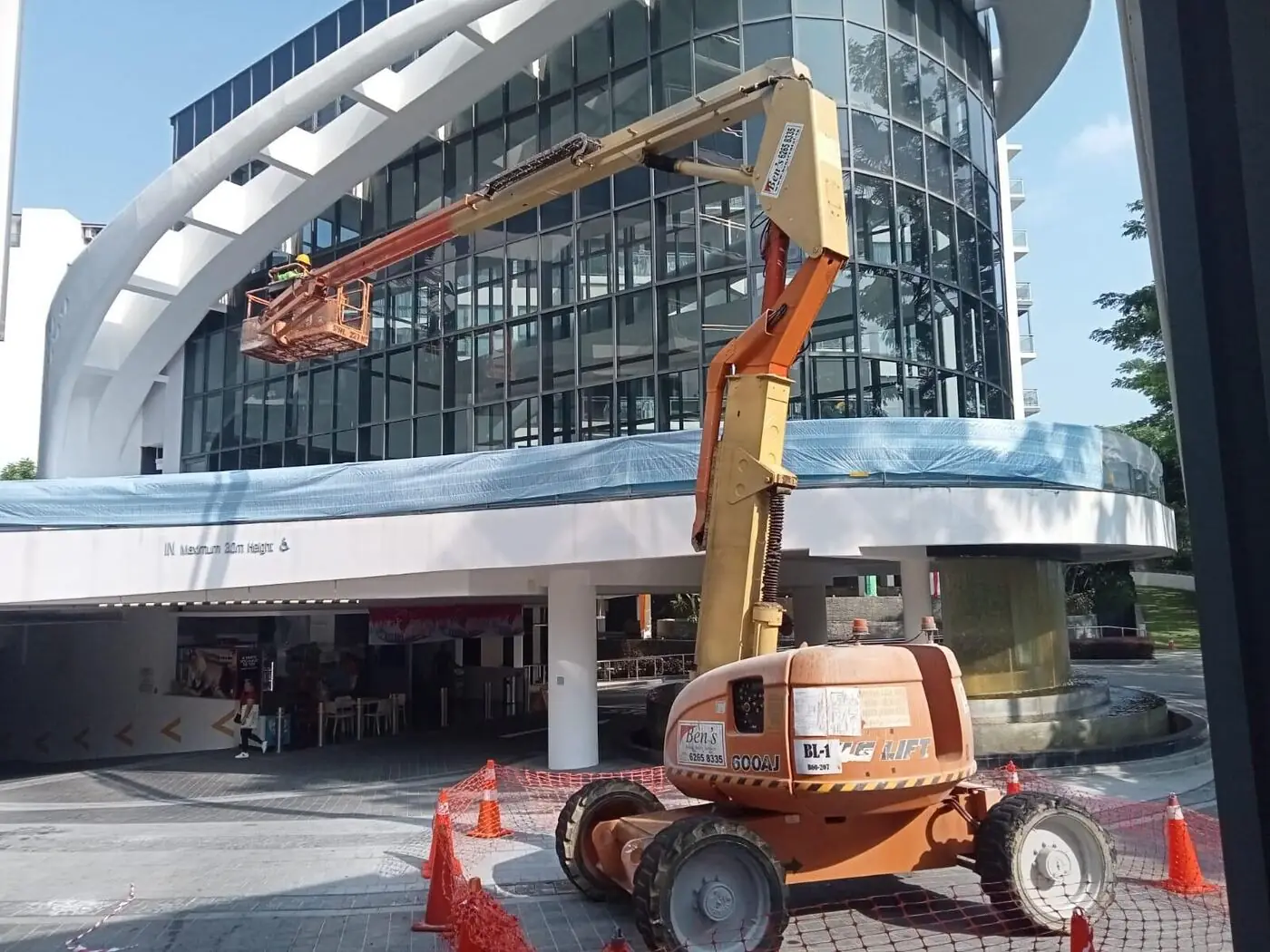
A self-propelled or vehicle-mounted machine with an extendable boom arm and personnel basket. Boom lifts provide articulated or telescopic reach. Scissor lifts are a related MEWP type providing vertical-only lift.
Best suited for
Low-to-mid-rise buildings with accessible, load-bearing ground or slab; projects requiring frequent repositioning, external light fitting replacement, signage installation and facade inspection up to the machine's rated working height.
Advantages
- Rapid mobilisation and repositioning — effective for short-duration tasks.
- No building-mounted anchorage required.
- Operator remains within the platform; direct control of position.
- Suitable for indoor and outdoor use depending on machine type.
Limitations
- Reach is limited by machine height rating and boom geometry — not suitable for most high-rise applications.
- Ground conditions must be assessed: soft soil, drainage covers, basement carpark slabs and kerb transitions all present stability risks.
- "Catapult effect" is a documented hazard on boom-type MEWPs when the boom strikes an obstruction.
- Operator should hold relevant MEWP training for the specific machine type (boom lift, scissor lift, vertical personnel platform).
Rope access
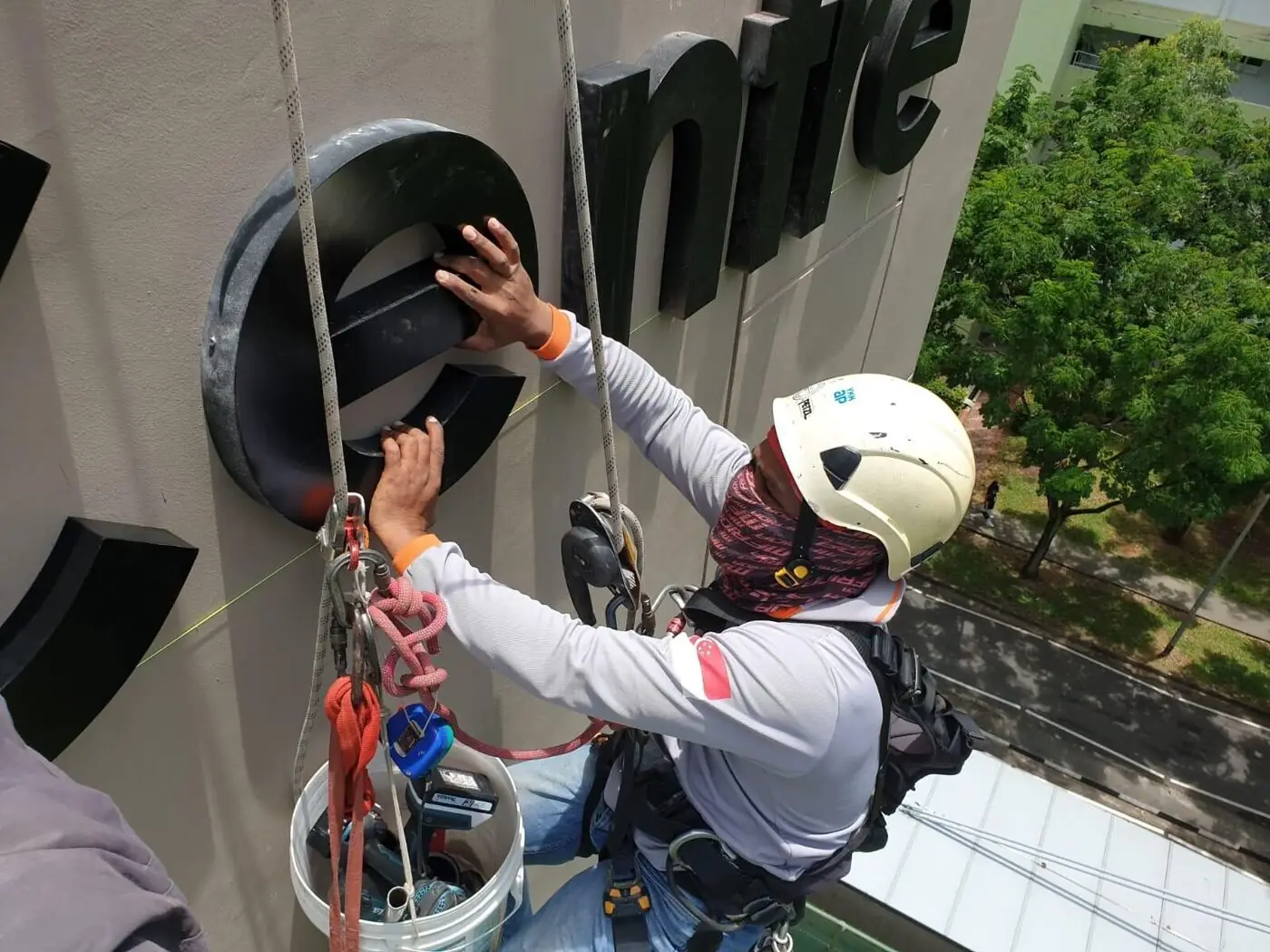
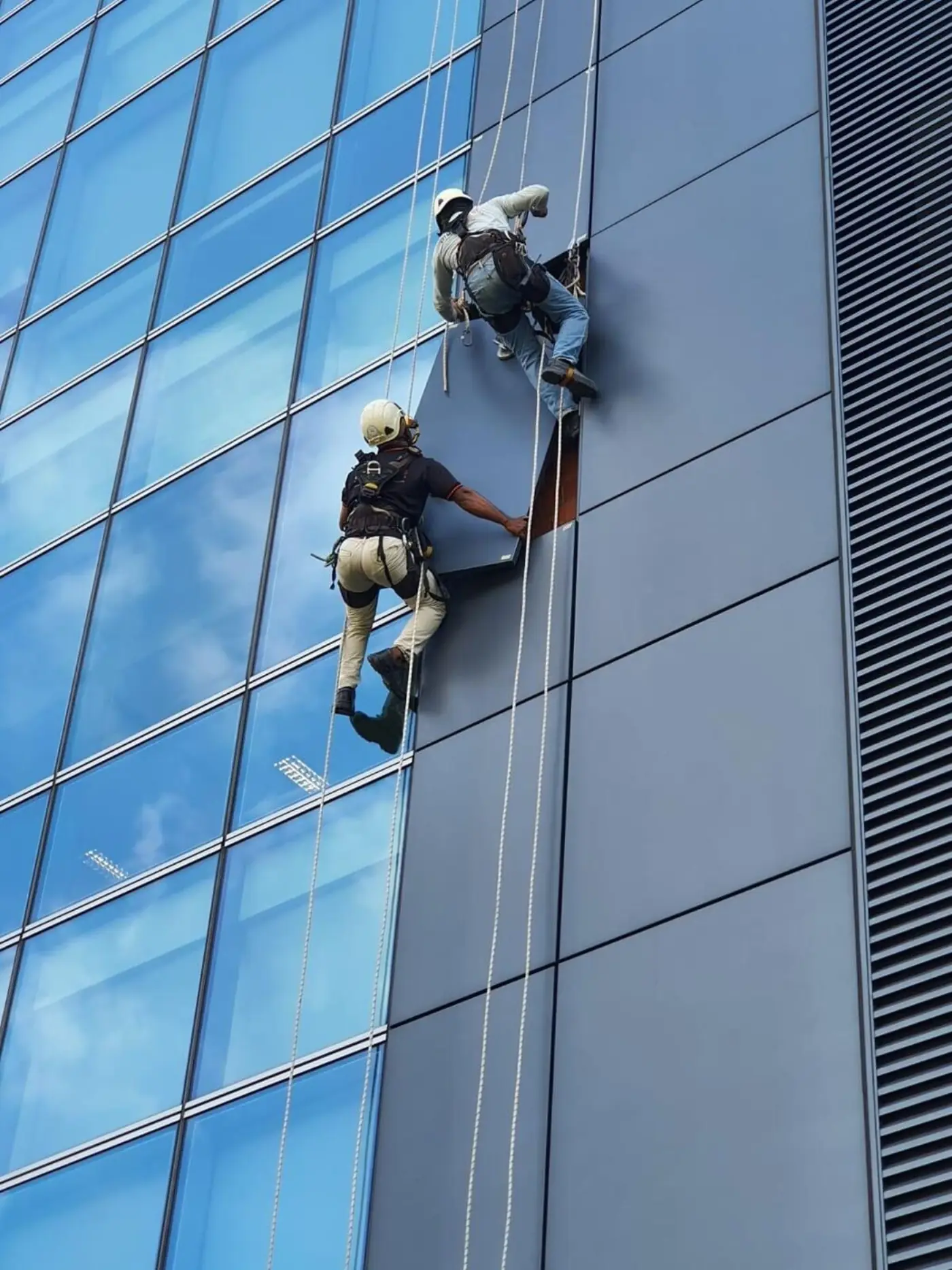
A technique in which trained technicians ascend, descend and traverse structures using twin-rope systems — one working rope and one safety rope — anchored at the top of the building or structure.
Best suited for
High-rise and complex facades where gondola suspension is not practicable, single-visit inspection and minor repair tasks, internal spaces and underside access, structures with no ground space for MEWPs, and locations where temporary scaffold erection is disproportionate to the scope.
Advantages
- Minimal ground footprint — no heavy equipment below the work area.
- Rapid rigging and de-rigging compared to scaffold.
- Accessible on complex geometries: curved facades, atria, bridge soffits, communications towers.
- Technicians are individually trained against established industrial rope access standards.
Limitations
- Relies entirely on personal fall protection — there is no collective platform.
- Requires suitable anchor points at the top of the structure; anchor assessment and loading calculations are required.
- Not suitable for sustained heavy work involving large tools or multiple simultaneous workers per station.
- Adverse weather, particularly wind, limits operational windows.
Comparison summary
| Factor | Scaffolding | Gondola | Boom lift | Rope access |
|---|---|---|---|---|
| Building height suitability | Any (with PE design above threshold) | High-rise | Low-to-mid rise | Any |
| Ground footprint | Large | Minimal | Medium | Minimal |
| Mobilisation time | Long | Medium | Short | Short |
| Multiple workers per position | Yes | Yes (limited) | No (1–2) | No (1 per rope set) |
| PE design required | Yes (above threshold) | Yes (outriggers / supports) | No | No (anchor assessment required) |
| Best for sustained works | Yes | Yes | No | No |
| Best for complex geometry | No | No | Limited | Yes |
The right starting point
Access method selection should happen during the planning phase, not after contracts are signed. The decision affects cost, programme, regulatory obligations and — most directly — the safety of the people carrying out the work.
Frequently asked questions
Can a contractor use any access method they prefer, or is there a prescribed hierarchy?
The WSH Code of Practice on Working Safely at Heights sets out a hierarchy of controls that generally favours collective protection where reasonably practicable. Contractors must document their selection rationale in the risk assessment.
What credentials should a rope access contractor in Singapore hold?
Technicians should hold current IRATA certification at the appropriate level, with a Level 3 Supervisor present for rope access operations. The contractor should also hold relevant WAH supervisor accreditation and current insurance.
Is a gondola on a Singapore high-rise always the most cost-effective option?
Not always. PE design review, AE examination and rigging time can make gondola access unsuitable for short-duration or localised work, especially where existing infrastructure is absent or in poor condition.
What does an Authorised Examiner do for a MEWP or gondola?
An Authorised Examiner approved by MOM conducts thorough examination of lifting equipment and lifting gear, verifying structural integrity, mechanical condition and safe working load before the equipment is put into service.
Does the access method affect the Permit-to-Work requirements?
Yes. Each access method has distinct hazards, so the PTW must confirm that the specific controls for that method are in place before work is authorised.
References
- WSH (Work at Heights) Regulations 2013
- WSH (Scaffolds) Regulations
- WSH (Risk Management) Regulations
- WSH Code of Practice on Working Safely at Heights (2nd Revision 2013)
- IRATA International
- MOM - Factsheet on WAH Amendment Regulations
- WSH Council - Work at Height resources
- MOM - WSH legislation and approved Codes of Practice