What the regulations require
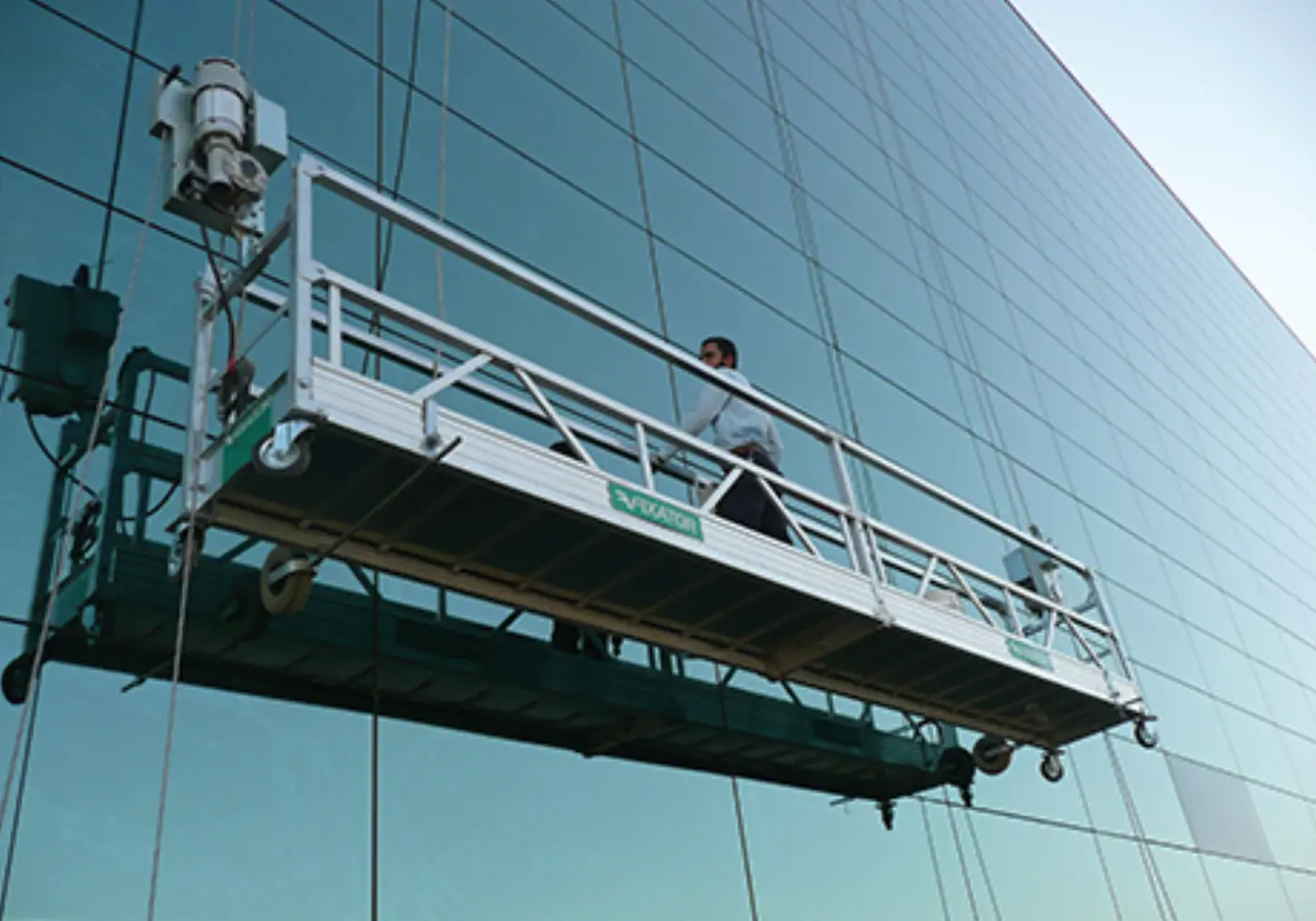
Suspended working platforms in Singapore are governed by the WSH (Scaffolds) Regulations, which classify suspended scaffolds (gondolas) as a type of scaffold and impose duties on principals, employers and contractors. The relevant Singapore Standard for suspended scaffolds sets out minimum requirements for system design, installation, testing, inspection, use and maintenance. MOM advisories on outrigger and overhead support design reinforce that these structures must be designed by a Professional Engineer.
Building owners commissioning gondola works should verify that a current PE design exists for the suspension system at their building.
The roles that must be in place
Professional Engineer (PE)
The outrigger or overhead support system from which the gondola is suspended should be designed by a registered PE. Where the building was constructed with a permanent gondola track or monorail, the PE design should already exist and should be reviewed for currency and condition.
Accredited scaffold contractor
The gondola system, including the suspended platform, wire ropes, hoist units and anchorage assembly, should only be assembled, installed, altered, repositioned, maintained, repaired or dismantled by an appropriately accredited scaffold contractor under the supervision of a competent scaffold supervisor.
Authorised Examiner (AE)
Before the gondola is put into use and at the intervals prescribed by regulation, an Authorised Examiner should thoroughly examine and test the system. The examination record should be retained on site and available for inspection.
Trained operators
Workers operating the gondola should be trained in the specific system they are using, including normal operating procedures, load management and emergency lowering procedures.
Safe Working Load: a non-negotiable limit
Every suspended working platform should have its safe working load (SWL) clearly and permanently marked. The SWL represents the maximum combined weight of workers, tools and materials that the platform is designed to carry. Exceeding the SWL stresses the hoist ropes, hoist mechanism and anchorage system simultaneously.
In practice, SWL overloading occurs when:
- Additional workers join the platform beyond the rated number.
- Heavy materials (tiles, cladding panels, paint drums) are loaded without accounting for worker weight.
- Tools and equipment accumulate on the platform during extended works.
Pre-use checks before every shift
- Wire ropes — visible condition; kinking, broken wires or corrosion are grounds for immediate removal from service.
- Hoist units — controls, brake function and emergency lowering confirm operational.
- Platform structure — floor, guardrails, mid-rails and toe boards free of damage; gate or access opening properly secured.
- Suspension system — outrigger positions confirmed against the PE-approved layout; safety slings or secondary suspension devices in place.
- PPE — full-body harnesses and lanyards for each worker; anchor points on the platform confirmed serviceable.
If any element is not serviceable, work does not proceed until the defect is resolved.
Travel restraint, work positioning and fall arrest
Workers on suspended platforms should be equipped with appropriate personal fall protection:
- Travel restraint — limits how far the worker can move so that they cannot reach a fall hazard; appropriate where the geometry of the platform is known and controlled.
- Work positioning — the harness and system support the worker in the working position, allowing hands-free operation.
- Fall arrest — activates to arrest a fall that has begun; last-resort protection.
On a gondola, the primary protection is the suspended platform itself. Personal fall protection equipment provides secondary and last-resort protection. Workers should anchor to designated anchor points on the platform — not to suspension ropes, outriggers or any part of the building facade.
Adverse weather: when to stop
Gondola operations should stop when:
- Wind speed exceeds the system manufacturer's rated limit — the platform becomes unstable and cannot be controlled at height.
- Rain significantly reduces visibility for the operator.
- Thunderstorm conditions are imminent — lightning risk to personnel on an exposed platform at height is not acceptable.
- The supervisor or competent person on the ground determines conditions are unsafe.
All workers should be lowered to ground level before weather deteriorates to an unsafe level. Operations should not resume until conditions have been assessed and confirmed safe.
Maintenance and examination records
- Wire ropes should be discarded at the intervals or conditions specified by the manufacturer or applicable standard.
- Hoist units should be serviced at the intervals specified by the manufacturer.
- Outrigger components should be inspected for corrosion, deformation and pin or bolt condition.
- All records should be accessible on site during works.
Where gondola equipment is stored on the building's roof between maintenance programmes, it should still be examined prior to re-commissioning. Storage does not pause the clock on examination requirements.
What building owners should verify
- PE design exists and is current for the suspension system at the building.
- The contractor engaged is appropriately accredited for scaffold and gondola work.
- Current AE examination records exist for the gondola system.
- Trained operators are assigned — not general labourers.
- A site-specific risk assessment and safe work procedure have been prepared.
- PTW is in place where required.
These are not onerous obligations — a competent contractor should produce all this documentation without being asked twice.
Frequently asked questions
Does every high-rise building in Singapore have a gondola system?
No. Many high-rise buildings have permanent gondola tracks or davit sockets, but older buildings, shophouses, low-rise blocks and many industrial buildings do not. A portable outrigger system, rope access or MEWP may be more appropriate.
Who is responsible for maintaining the gondola infrastructure at a building?
The building owner or MCST is responsible for permanent infrastructure such as monorails, davit sockets and fixings. The WAH contractor is responsible for the portable gondola system they bring to site.
How often must a gondola system be examined by an Authorised Examiner?
Examination intervals are prescribed under the WSH (Scaffolds) Regulations. The AE certificate states the next due date, and a fresh AE examination is required after alteration, repair or incident before return to service.
Can gondola operators use the gondola structure as an anchor for their safety line?
No. Each operator's lifeline must be connected to an independent anchor that is structurally separate from the gondola suspension system.
What should be done if a wire rope on the gondola appears worn or corroded?
The gondola must be taken out of service immediately. The defect should be reported, the wire rope replaced by an accredited scaffold contractor, and the replacement examined by the AE before return to service.
References
- WSH Act (Cap. 354A)
- WSH (Work at Heights) Regulations 2013
- WSH (Scaffolds) Regulations
- WSH Code of Practice on Working Safely at Heights (2nd Revision 2013)
- WSH Council - Work at Height resources
- MOM - WSH legislation and approved Codes of Practice
- MOM - Factsheet on WAH Amendment Regulations
- WSH (Risk Management) Regulations