What the law requires
The Workplace Safety and Health (Risk Management) Regulations require all employers, self-employed persons and principals — including contractors and subcontractors — to identify safety and health hazards and implement risk controls for all work activities. This obligation applies to work at height regardless of building type or industry sector. Detailed guidance on how to conduct an RA, prepare a Risk Register and keep records is set out in the MOM-approved Code of Practice on WSH Risk Management.
The WSH (Work at Heights) Regulations impose an additional, specific obligation: a Permit-to-Work system is required for hazardous work at height as defined in the regulations — generally, work where a person could fall from a height that triggers the regulatory threshold, including falls into a depth.
For building maintenance and inspection works at completed buildings, the responsible person should still review whether a PTW process is required. MOM's Permit-to-Work guidance provides the structured process that many building owners and managing agents now require as a contractual condition.
The risk assessment: structure and content
A risk assessment for work at height should follow the three-step process referenced in the Code of Practice on WSH Risk Management:
Step 1 — Hazard identification
Identify every potential hazard relevant to the specific task and location. For high-level works this includes:
- Falls from height (worker falls from platform, scaffold or rope system).
- Falling objects (tools, debris, fixings dropping to the ground level below).
- Struck-by hazards (from adjacent work activities).
- Equipment failure (rope failure, hoist malfunction, outrigger collapse).
- Structural hazards (fragile roofs, unstable parapets, corroded anchorage).
- Environmental hazards (wind, rain, lightning, sun exposure).
- Rescue failure (inability to lower a suspended worker quickly in an emergency).
Step 2 — Risk evaluation
For each hazard, assess the likelihood of occurrence and the severity of potential harm. Use a risk matrix and assign a risk rating. The assessment should be specific — a generic template with pre-filled ratings does not reflect the actual site conditions and is not an adequate risk assessment.
Step 3 — Risk control
Apply controls in the hierarchy of control:
- Elimination — can the work be done without WAH? (ground-level inspection using cameras, for example).
- Substitution — can a safer access method be used?
- Engineering controls — guardrails, edge protection, collective fall protection.
- Administrative controls — PTW system, safe work procedures, supervision, training.
- PPE — personal fall arrest, travel restraint, helmets, gloves.
Controls at the top of the hierarchy are more effective than those at the bottom. Relying primarily on PPE as the sole control for a fall hazard is not consistent with the hierarchy.
The Fall Prevention Plan (FPP)
The FPP is required under the WSH (Work at Heights) Regulations for sites where work at height is being carried out. It should be prepared before hazardous WAH begins and should include:
- Fall prevention policy.
- Roles and responsibilities of all parties.
- Identified WAH hazards and the risk assessment outcomes.
- Safe work procedures for the access method being used.
- PPE requirements and inspection procedures.
- Equipment inspection and maintenance protocols.
- Training records for all workers.
- Emergency rescue plan.
The FPP is not a replacement for the RA — it is a higher-level framework that the RA feeds into.
The Permit-to-Work system: four stages
Stage 1 — Hazard identification by the supervisor and workers
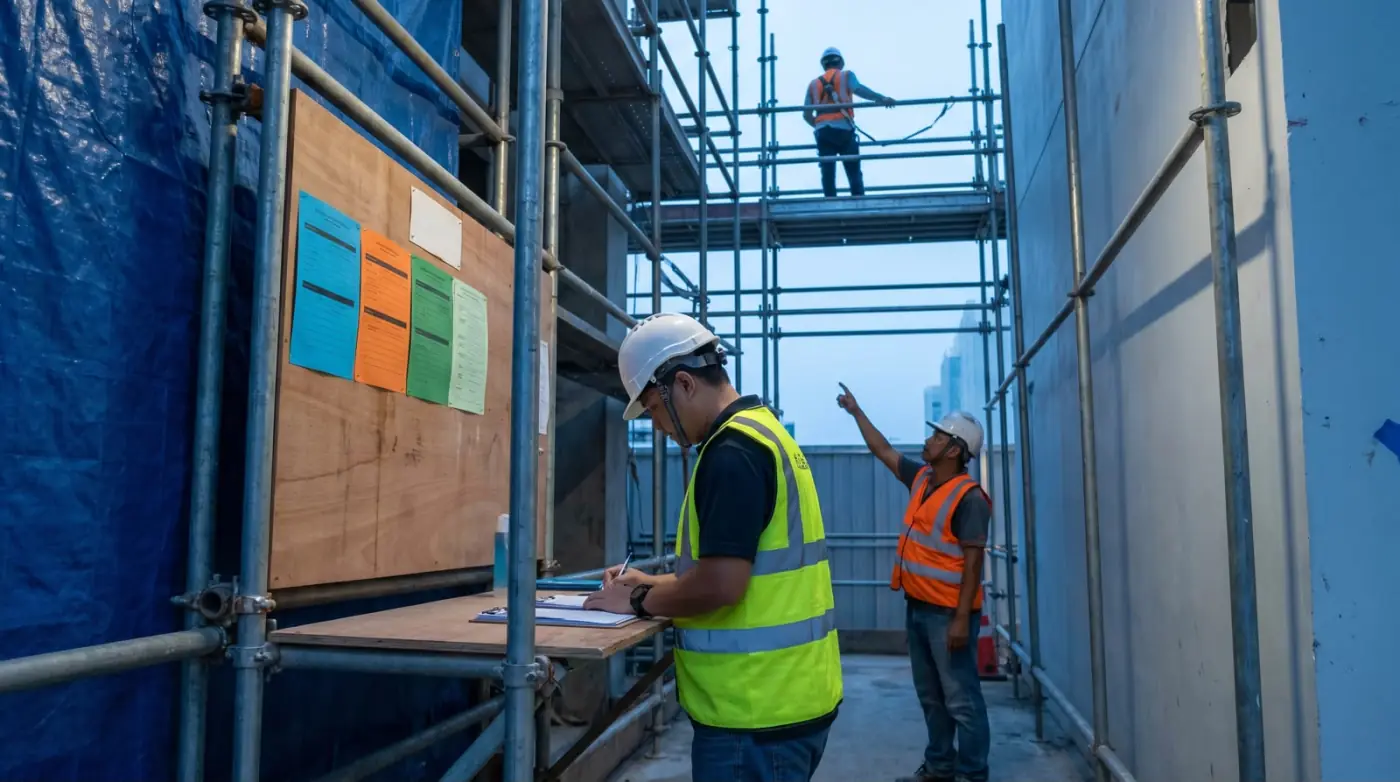
Before applying for a permit, the supervisor and workers visit the work location, identify all potential hazards, verify that control measures are in place or can be implemented, and confirm that conditions match those captured in the risk assessment. Work does not begin at this stage.
Stage 2 — Application by the supervisor
The supervisor completes the PTW application form, confirming that an RA has been conducted for the specific work, that all safety control measures will be implemented, and that all workers have been briefed. The application is submitted to the appointed WAH Safety Assessor.
Stage 3 — Evaluation by the WAH Safety Assessor
The WAH Safety Assessor visits the site with the supervisor and physically verifies that all safety conditions stated in the PTW can be met. The Assessor may specify additional controls. Once satisfied, the Assessor signs the PTW and forwards it to the Authorised Manager.
Stage 4 — Approval by the Authorised Manager
The Authorised Manager reviews and approves the PTW when satisfied that all hazards and risks have been adequately addressed, all reasonably practicable safety measures are in place, all persons involved have been informed, and no incompatible works are occurring concurrently. Work may begin only after the Authorised Manager has approved and issued the permit.
Common risk assessment failures
- Generic templates not adapted to the specific site, access method or task.
- Pre-filled risk ratings that do not reflect actual conditions.
- Controls limited to PPE, with no engineering or collective controls identified.
- Missing rescue plan — no documented procedure for rescuing a suspended or incapacitated worker.
- No weather contingency — no criteria for stopping and resuming work in adverse conditions.
- Outdated documents — RA prepared for a previous project and reused without review.
A risk assessment should be reviewed before each new phase of work and updated whenever site conditions, access methods or work scope change. Under the Code of Practice on WSH Risk Management, the RA should be reviewed at least once every three years from the approval date, and earlier upon significant change or incident.
Retaining records
PTW forms, risk assessments, FPPs and toolbox-talk records should be retained throughout the project and for the period required by regulation. The WSH (Risk Management) Regulations require RA records to be kept for at least three years from the RA approval date. At building maintenance sites, these records form the project safety file and should be handed to the building owner upon project completion.
Frequently asked questions
Who can be a WAH Safety Assessor in Singapore?
A WAH Safety Assessor must hold the relevant accreditation under the WSH framework and is responsible for evaluating the PTW against the risk assessment and physically verifying controls before work is approved.
Is a Permit-to-Work always required for work at height in Singapore?
Not for every WAH activity. It is required for hazardous WAH work as defined by regulation, although many building owners and main contractors require PTW as a contractual condition for site access.
Can the risk assessment and Permit-to-Work be combined into one document?
They serve different functions. The risk assessment analyses hazards and controls, while the PTW is the operational gate confirming that the required controls are actually in place on the day.
What happens if conditions on site change after the PTW is issued?
The PTW must be suspended and re-evaluated. Work should not resume until the changed condition is assessed and a revised PTW is issued where required.
How does the Fall Prevention Plan relate to the risk assessment?
The FPP is the broader site or project-level fall prevention document. The risk assessment is task-specific and should be consistent with the FPP.
References
- WSH Act (Cap. 354A)
- WSH (Work at Heights) Regulations 2013
- WSH (Risk Management) Regulations
- WSH Code of Practice on Working Safely at Heights (2nd Revision 2013)
- MOM - Permit-to-Work systems
- MOM - Factsheet on WAH Amendment Regulations
- WSH Council - Work at Height resources
- MOM - WSH legislation and approved Codes of Practice